10月9日,《求是》(英文网)发布广西师范大学4名留学生全程出镜拍摄的《平陆运河奇妙游|奇妙的运河》第一集(共四集),现播出第一集出镜学生为泰国留学生王健云。节目介绍了平陆运河这项世纪工程的独特价值、河道上蕴含的奇妙故事。
现将报道转载分享。
On September 16, 2026, the Pinglu Canal was officially opened to navigation. As China's first canal that has been planned and coordinated at the national level since 1949, it serves as a backbone project of the New International Land-Sea Trade Corridor in western China. What unique value does this landmark project bring? What highlights does it hold? And what wonderful stories lie along its 134.2-kilometer waterway? Join us on a wonderful journey with the bilingual short-video series Wonderful Tour on the Pinglu Canal.
Guangxi Zhuang Autonomous Region is itself "a living chronicle of water conservancy." In northern Guangxi, the Lingqu Canal in Xing'an County, Guilin City, built in the Qin Dynasty (221-206 BC), divides the flow with the huazui (plowshare-shaped spur), regulates it with the Big and Small Balance Weirs and lifts boats with its doumen (ancient Chinese lock gates); its 36 doumen raise vessels step by step over the mountain ridge. It is known as the "father of the world's ship locks" and praised as "a pearl of the world's ancient water conservancy architecture." In southern Guangxi, the Pinglu Canal sets out from the Pingtang River mouth in the county-level city of Hengzhou in Nanning, runs through Lingshan County in Qinzhou and follows the Qinjiang River into the Beibu Gulf, using its three hubs of Madao, Qishi, and Qingnian to overcome a natural drop of about 65 meters. The Lingqu Canal relies on a workforce to store and release water so that boats can "climb the stairs." In contrast, the Madao Hub ship lock of the Pinglu Canal, whose three-tier superimposed water-saving basins cut water use by more than 60 percent, has upgraded "ancient water control" into "digital and intelligent water saving." Wang Jianyun, a young man from Thailand, walked into the Lingqu Canal and the Pinglu Canal, and came to understand the Chinese wisdom on water management that has been passed down through the ages from the thousand-year-old doumen to modern water-saving ship locks.
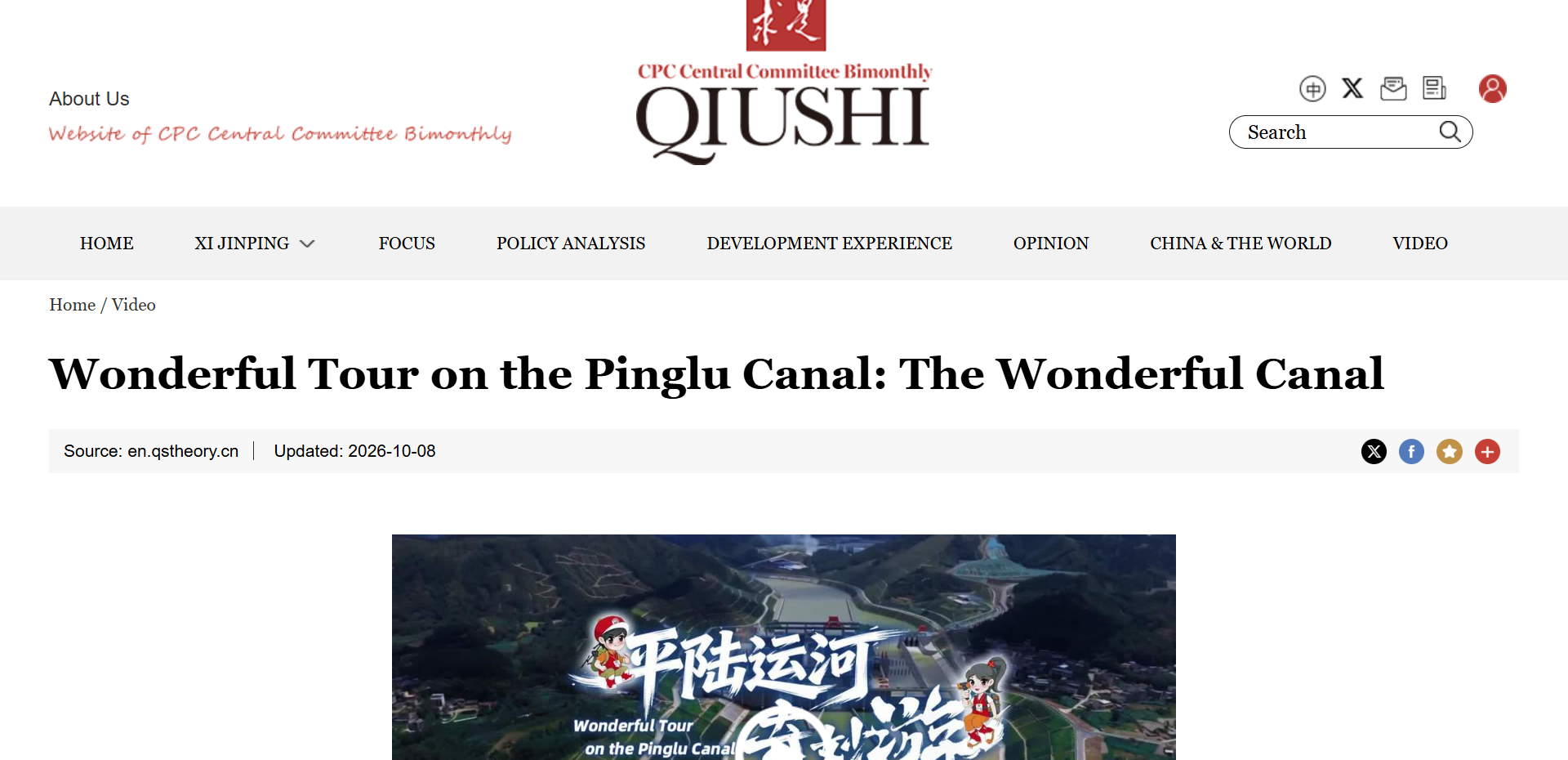
报道截图
 分享
分享
广西师范大学新闻网版权与免责声明:
① 凡本网未注明其他出处的作品,版权均属于广西师范大学新闻中心,未经本网授权不得转载、摘编或利用其它方式使用上述作品。已经本网授权使用作品的,应在授权范围内使用,并注明“来源:广西师范大学新闻网”。 违反上述声明者,本网将追究其相关责任。
② 凡本网注明其他来源的作品,均转载自其它媒体,转载目的在于传递更多信息,并不代表本网对其负责。
③ 有关作品内容、版权和其它问题请与本网联系。
※ 联系方式:广西师范大学新闻中心 Email:xinwen@gxnu.edu.cn
友情链接
联系方式

官方微博

官方微信

师大校报

独秀之声

 点赞
点赞 评论
评论




 点击排行
点击排行 推荐阅读
推荐阅读